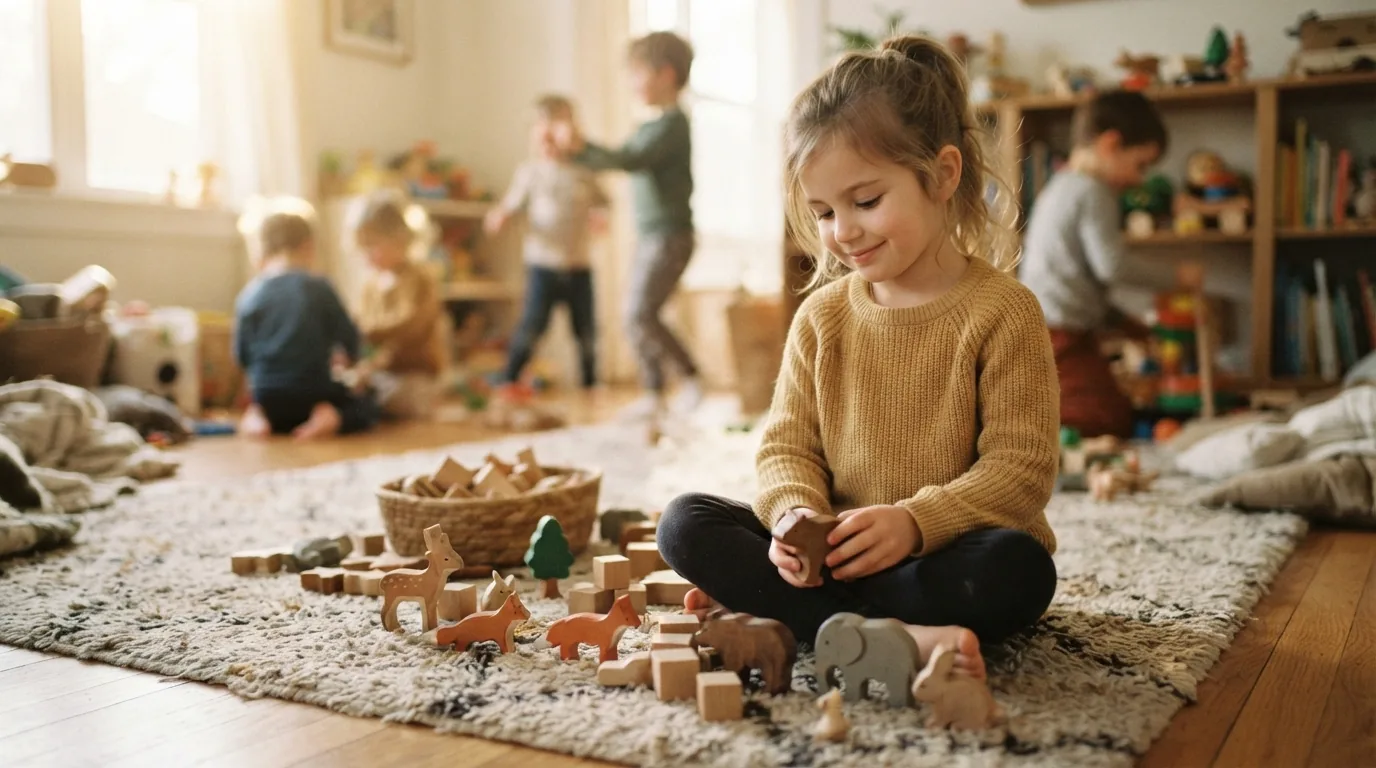
You are at a party. Your child is on the floor with the animals, alone, while the others tear around together. Something in your chest tightens.
Research published this year looked at exactly those children — the ones who look unsociable in a room full of play. Its conclusion was more comforting and more precise than the usual reassurance.
Some children playing alone are simply choosing solitude, and they are fine. But the study identified the condition that makes it fine: those children knew they belonged. They knew that if they wanted in, the others would have them. That knowledge acted as a buffer against loneliness.
The distinction that changes what you watch for
Two children can look identical on a carpet and be having opposite experiences.
- Solitude is chosen. The child is absorbed. They will look up when something interesting happens, then go back. If invited, they might join or might not, and either answer is easy.
- Exclusion is not chosen. The child is watching the other group more than their own game. Their play is thin — it keeps stopping. They are near the group but angled away, which is how a child stays available without risking a refusal.
The tell is not whether they are alone. It is where their attention is. A contented solitary player is inside their own game. An excluded child is somewhere else entirely, holding a toy.
The larger thing that is genuinely worth worrying about
There is a real trend behind the anxiety, and it is not about introverted children. Work published in The Journal of Pediatrics makes the case that the decline in children's mental wellbeing tracks the decline in their opportunities to play and roam independent of adult supervision.
Play is how children make friends — unsupervised, unscheduled, with the negotiation and the falling out and the making up all included. Remove it and you have removed the workshop where friendship gets built, which is a different and much bigger problem than one child preferring the animals.
What to do at the party
- Do not send them in. "Go and play with the others" tells a child that how they are is wrong, and adds an audience.
- Check the belonging, not the behaviour. Later, casually: "Who did you sit with at lunch?" You are testing whether the door is open, not whether they walked through it.
- Protect unsupervised time. Not another club. An afternoon with one friend and no plan does more for friendship than a term of organised activity.
- Watch over weeks, not moments. One party proves nothing. A child who never has anyone to sit with is a different signal, and that one is worth acting on.
Most of the time the child on the floor with the animals is exactly where they want to be. The question is only whether the door is open — and that you can ask about without ever mentioning the party.