Almost nothing in parenting research produces a clean line. Reading to your child produces a clean line.
Researchers working with the Japan Environment and Children's Study followed 36,866 mother-child pairs and tracked how often families shared storybooks up to age three. The result held across every developmental domain they measured, and it survived the usual objections — it was still there after accounting for parental background, for how much the family played together, and for screen time.
The more often families read together, the higher the children scored. Not in one area. In all of them.
Then someone tested whether you have to do it properly
This is the part that should take some weight off.
There is a whole genre of advice about how to read to a child: stop and ask questions, point at things, get them predicting what happens next. It is good advice. It is also one more thing to get wrong at the end of a long day.
So a research team ran the comparison over fourteen bedtimes. One group of parents paused and asked questions. The other just read the book.
Children in the question group got better at understanding other people's perspectives. So did the children whose parents simply read straight through. After two weeks, children in both groups had improved at creative thinking.
Fourteen bedtimes. Two weeks. That is the whole intervention.
Why a book does something a video does not
A screen tells the story at its own pace and fills in every gap. A book waits.
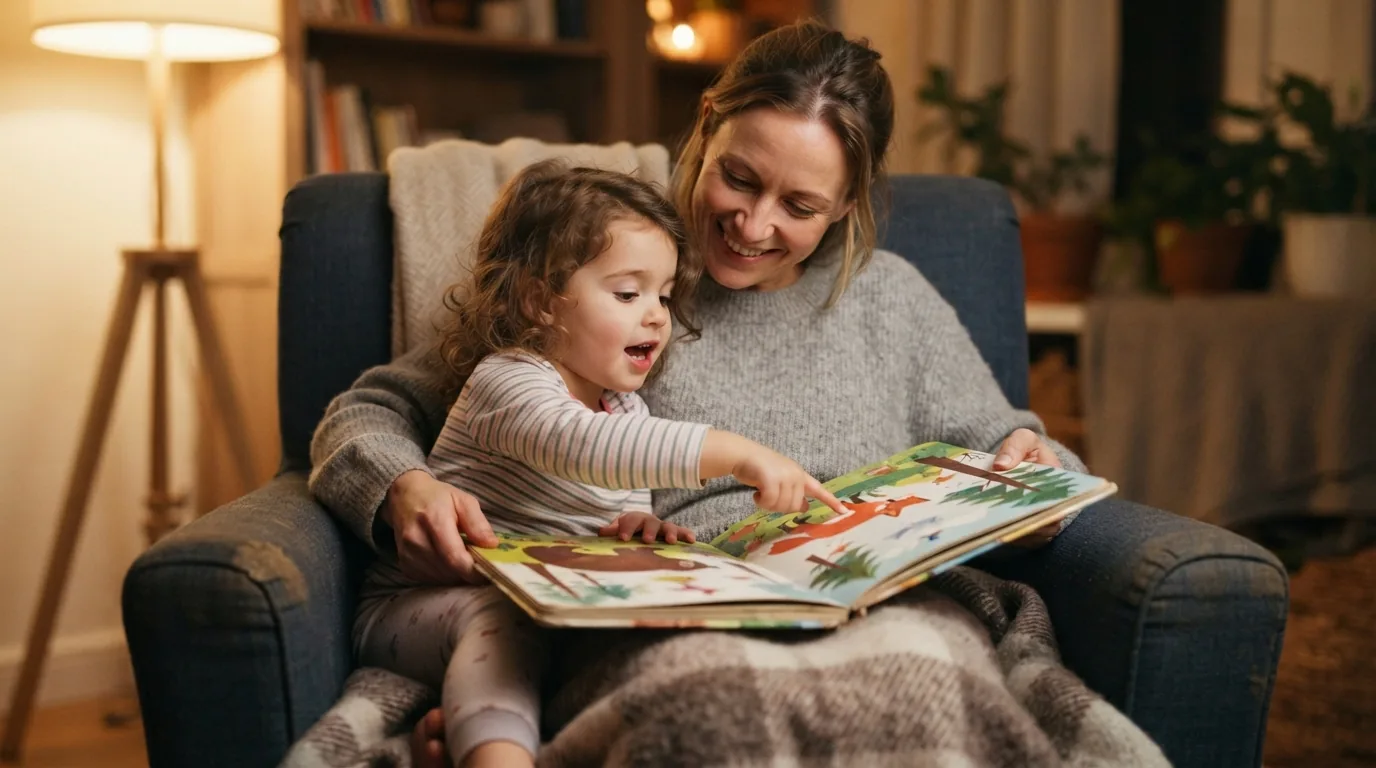
In that waiting, a child has to build the picture themselves — what the room looks like, what the character sounds like, why anyone did anything. And crucially, you are right there, which means a question is possible, and a hand is available, and a page can be gone back to because they liked it.
The book is doing some of the work. The rest of it is you, sitting still, for eight minutes.
If you take one thing
Stop trying to read well. Read often, badly, at whatever hour you can manage, with as many funny voices as you have energy for and none if you have none.
The children in that study did not benefit from technique. They benefited from frequency — and frequency is the one thing an exhausted parent can actually deliver.