Typing is faster, neater, and easier to correct. For a child learning to read, all three are disadvantages.
Researchers using high-density EEG compared what happens in the brain during handwriting and during typing. Handwriting produced widespread connectivity across brain regions. Typing did not — the same words, the same child, a markedly quieter pattern.
A separate line of work on prereaders found the practical consequence. Children learning letter-sound mappings in an unfamiliar alphabet learned them more accurately by hand than by keyboard, and the advantage carried through to identifying, writing and decoding whole words.
What the hand is doing for the brain
Every letter you write by hand is a different movement. The a is a small closed loop with a tail. The k is a stroke and two angles. Your hand has to know something about the shape in order to produce it.
On a keyboard, every letter is the identical motion — a finger going down — landing in a different place. The letter arrives fully formed and the child had nothing to do with making it.
So handwriting attaches a movement to each shape, and the brain gets two routes to the same letter instead of one. The tactile and motor experience is not decoration around the learning. In early literacy it appears to be part of the mechanism.
The slowness is the point
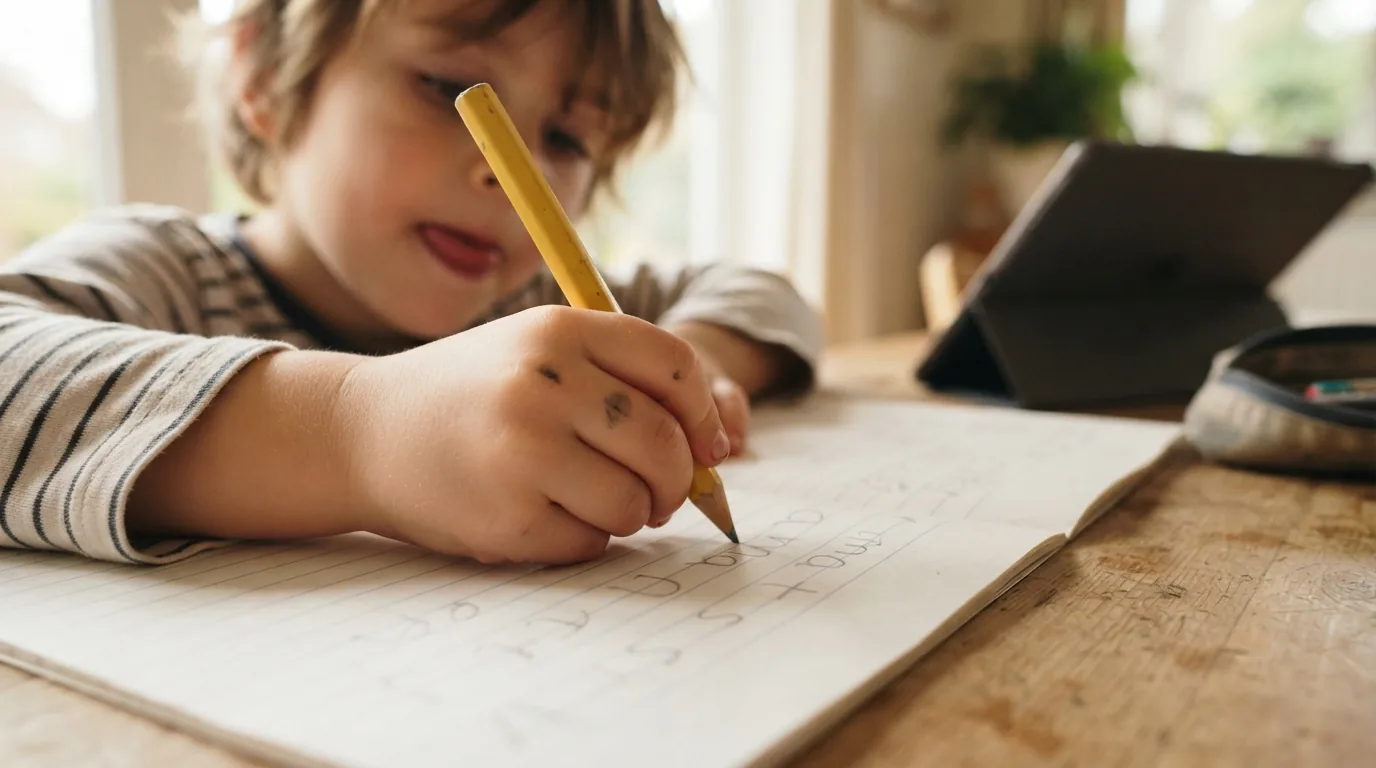
Handwriting is more cognitively demanding, and that is exactly why it works. The extra effort forces a deeper pass over the material — you cannot write a word by hand while thinking about something else in the way you can type one.
Which is worth remembering the next time a child grinds through a sentence with their tongue out. That is not the task going badly. That is the task.
This is not an argument against keyboards
Children need to type. They will type for the rest of their lives, and a child who cannot type fluently at fifteen is at a real disadvantage.
The argument is about order. Hand first, while the letters are being learned — then the keyboard, once the shapes are secure. Researchers in this area keep making the same recommendation: integrate handwriting practice alongside digital literacy in early childhood rather than replacing one with the other.
Five minutes, not a programme
None of this requires worksheets. Shopping lists, labels on drawings, a note left for someone, a birthday card written out properly rather than signed.
Anything where a child forms letters for a reason they care about will do more than a page of practice they were told to complete.