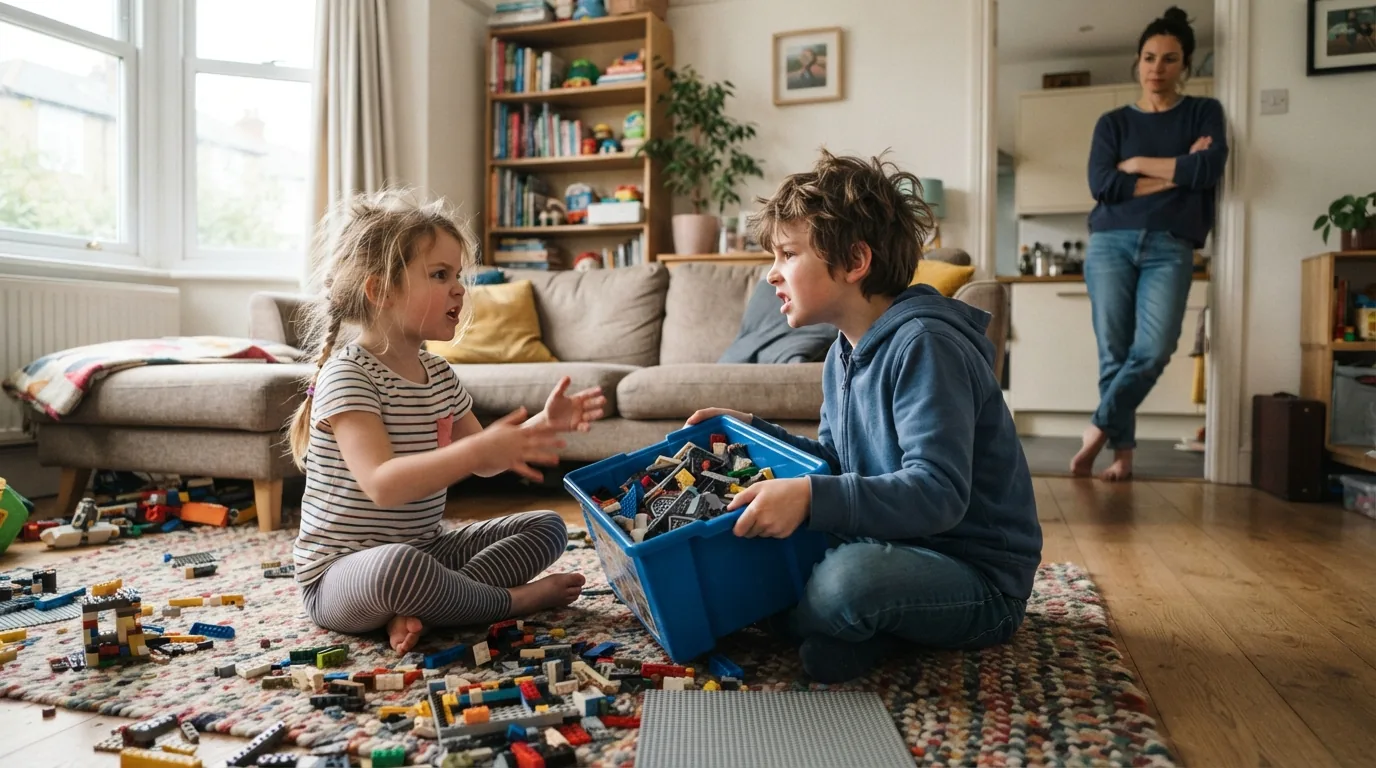
By the time you have crossed the kitchen, both children will explain that the other one started it. Both will be telling the truth.
Sibling conflict is one of the few areas of family life where the research is genuinely reassuring: it is developmentally normal, and it is doing something. Siblings are where children learn to negotiate, to lose an argument and remain in the room, and to repair a relationship they cannot walk away from.
You do not get that from friendships at this age. A friend who annoys you can be avoided. A brother is still there at breakfast.
When parents actually do step in
Observational work finds parents intervene fairly predictably: when a conflict has gone on a long time, when it turns aggressive, or when something gets broken.
Those are decent instincts, and beyond keeping children safe, stepping in at those moments does useful work — it lowers the temperature and it reasserts that the household has rules.
The problem is not the intervening. It is what most of us do once we have arrived.
The trap of arriving as a judge
The default move is to establish what happened and rule on it. It is almost irresistible and it is usually counterproductive.
You did not see the start. You are ruling on contested evidence supplied by two interested parties. Whatever you decide, one child learns they were right and the other learns the system is rigged — and both learn that the way to win an argument with your sibling is to get a parent involved faster next time.
You have not resolved the conflict. You have taught them to escalate it.
Arrive as a referee instead
A referee does not decide who deserved the ball. A referee restarts the game under the rules.
- Name the problem, not the culprit. "There is one tower and two builders." Now they are facing a shared problem rather than each other.
- Ask for the solution. "What would be fair here?" Six-year-olds produce surprisingly workable answers when the alternative is a parent producing one.
- Do not ask who started it. You will never find out, and the question itself is what they are competing over.
- Separate for calm, not as punishment. "Different rooms for ten minutes, then we sort it out" is regulation. Sending one child away as the guilty one is a verdict you cannot support.
The line that is not negotiable
All of the above applies to conflict. It does not apply to cruelty.
Ordinary sibling conflict swings — the same two children who were screaming are on the sofa together an hour later. What is not ordinary is one child consistently on the receiving end, contempt rather than anger, or fear. Research on sibling aggression is clear that this is a different category and needs an adult to name it and stop it, not a referee.
Everything short of that line, though, is a workshop. Noisy, repetitive, deeply irritating on a Sunday afternoon — and one of the more useful things happening in your house.