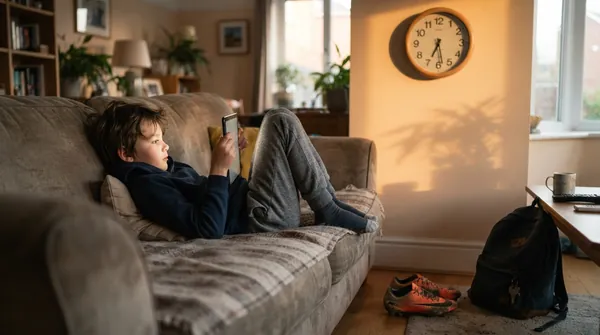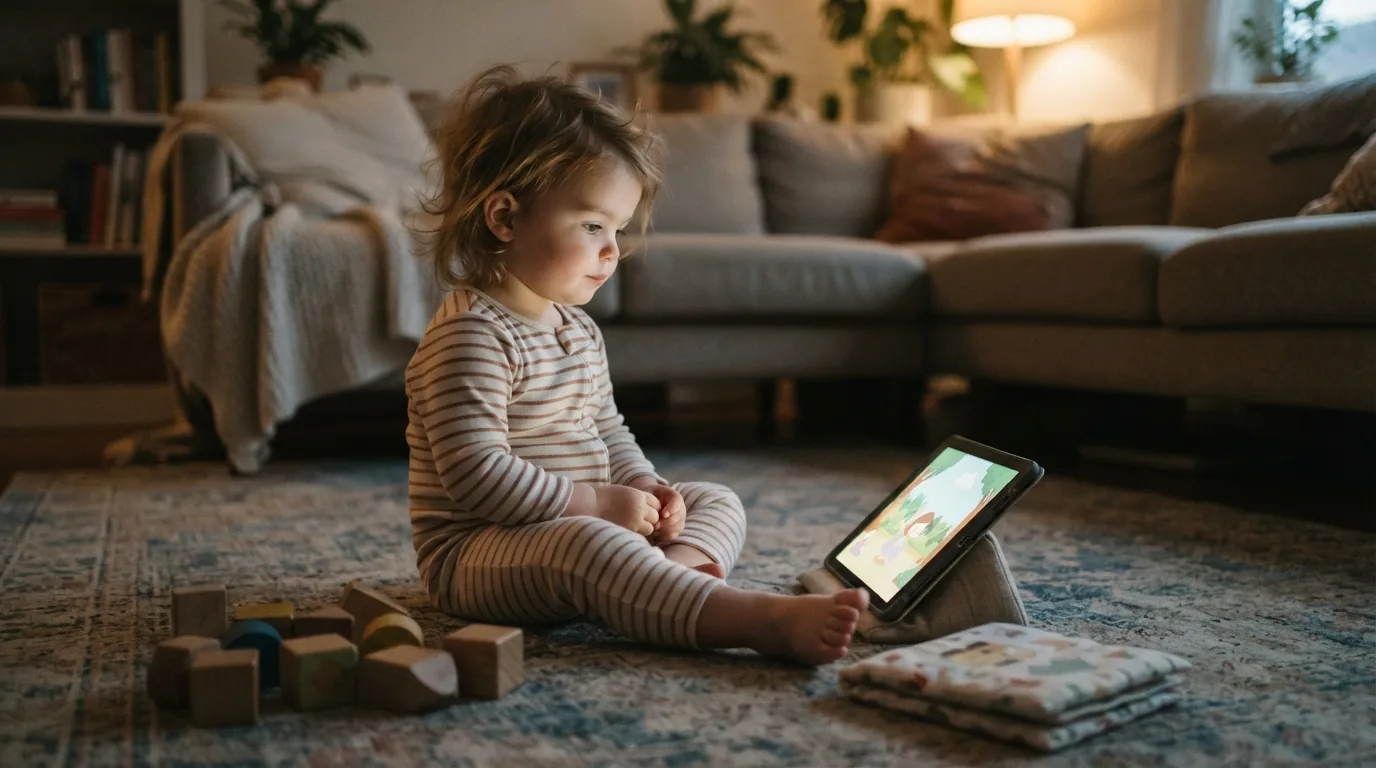
For over a decade, parents have been told to limit screen time, but the reasoning behind that advice has often stayed vague. A large longitudinal cohort study tracking children from infancy through school age has now given us some of the clearest evidence yet on what early, heavy screen exposure actually does — and, just as importantly, what it does not do.
The study followed children at 24, 36, and 60 months of age, measuring screen time through parent-reported questionnaires and later assessing developmental outcomes with standardized screening tools covering communication, motor skills, problem-solving, and personal-social development. The finding that drew the most attention: children with higher screen exposure at 24 months showed measurably poorer performance on developmental screening at 36 months, across multiple domains rather than just one.
What makes this research more convincing than earlier, smaller studies is the direction of the analysis. Researchers controlled for the reverse explanation — that children who are already developing more slowly simply get parked in front of a screen more often. The data showed exposure at the earlier time point predicting outcomes at the later one, which strengthens (without single-handedly proving) the case that screen time itself is doing some of the work, rather than merely tracking alongside it.
None of this means screens are inherently harmful in every context. The researchers were careful to note that content quality, whether a caregiver watches alongside the child, and what screen time is displacing (unstructured play, conversation, sleep) all matter enormously. A toddler watching a slow-paced, narrative program with a parent narrating alongside them is not doing the same thing, neurologically or socially, as a toddler alone with fast-cut content for three hours.
For parents, the practical takeaway isn't panic — it's specificity. The American Academy of Pediatrics' guidance of avoiding screens (aside from video-chatting) under 18-24 months, and limiting high-quality programming to about one hour a day for ages 2-5 with a co-viewing adult, lines up well with what this cohort data shows. The goal isn't a screen-free household; it's making sure screens aren't quietly replacing the hands-on, face-to-face interactions that early brain development actually runs on.
Kaynaklar: Madigan et al., JAMA Pediatrics 2019 (doi:10.1001/jamapediatrics.2018.5056); AAP "Media and Young Minds", Pediatrics 2016; McArthur et al., JAMA Pediatrics 2022.