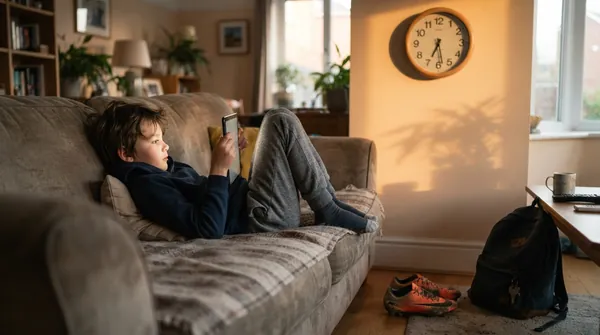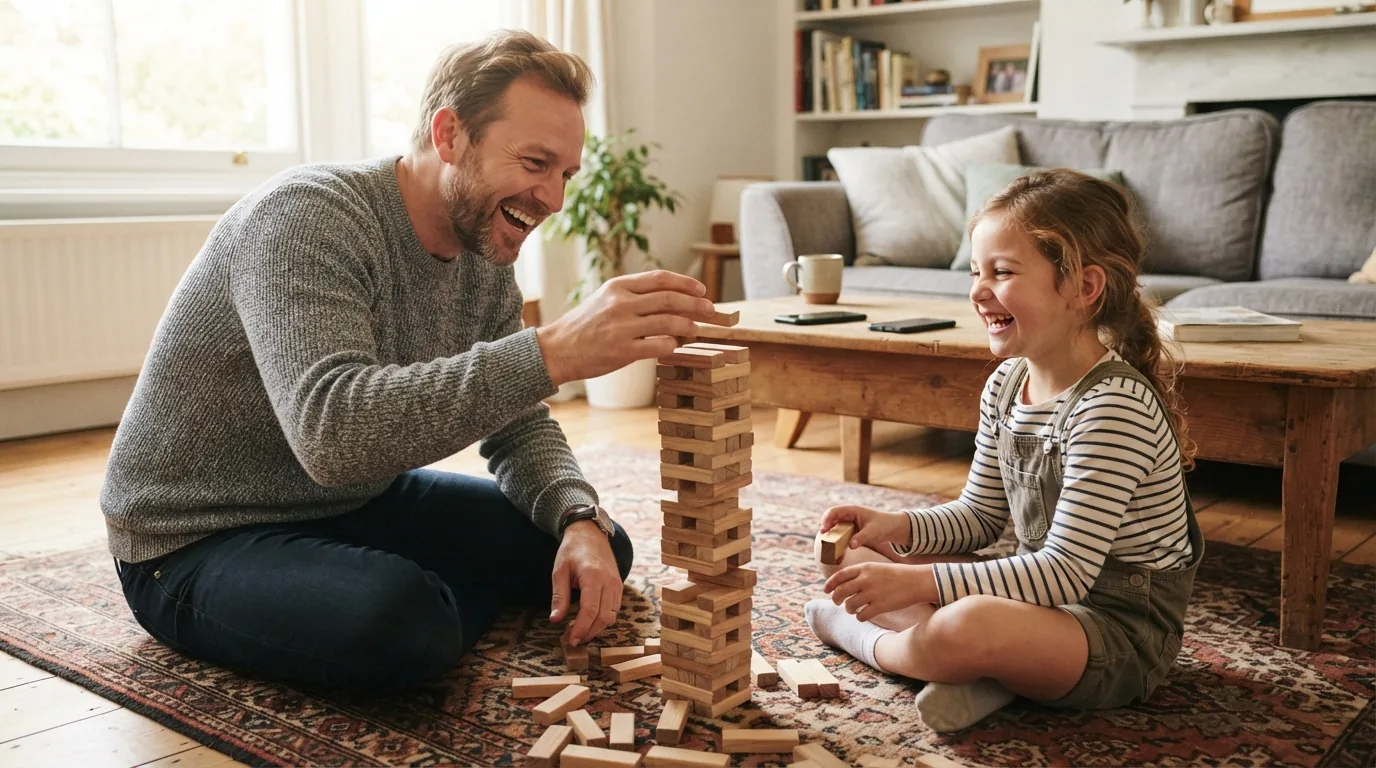
There is a particular silence that settles over a living room in the evening. Everyone is present. Nobody is there.
You know the one. Two adults on the sofa, a child on the rug, three screens glowing, and nobody has said a word for twenty minutes. Not an argument. Not a bad night. Just a room full of people who have quietly gone somewhere else.
A team of researchers put a name to what that costs. They looked at families in what they call our hyperconnected culture and found the same thing families keep finding on their own: the devices are not stealing whole evenings. They are stealing the small moments between things — the gap after school, the five minutes before dinner, the bit at bedtime where a child decides whether to tell you something.
Those gaps are where most of a childhood actually gets talked about.
Why "we spend time together" can still be true and not enough
Most families are in the same room plenty. The question is whether anyone is available in it.
Children are exact about this in a way adults find uncomfortable. They can tell the difference between a parent who is listening and a parent who is looking up between glances at a phone — and after a few rounds of the second one, they stop starting conversations. Not dramatically. They just do not bother.
That is the real cost, and it does not show up as a fight. It shows up as a house that got quieter and nobody noticed when.
The experiment: one hour, not one weekend
Digital detox has a branding problem. It sounds like a retreat you cannot afford, in a cabin you do not have, over a weekend nobody in your family has free.
So make it smaller than that. One hour. The same hour, most days. Phones in a drawer, in a bowl, in another room — somewhere that requires standing up.
Here is the part people get wrong: the hour is not for family activities. It does not need a craft. Nothing has to be enjoyed. The hour exists so that when your eight-year-old decides at 6:40pm to tell you about the thing that happened at lunch, there is somebody available to tell.
What to expect, honestly
- The first three evenings are dull. Genuinely, boringly dull. Everyone will feel it. This is withdrawal, not failure — the room has to get quiet before anyone fills it.
- Your children will test whether you mean it. The first time your phone comes out "just for a second," the experiment is over and they will remember that it was.
- Nothing profound will be said. Not at first, and possibly not for weeks. The conversations that matter arrive sideways, in the middle of something else, and only in rooms where they have somewhere to land.
- You will want your phone. More than you expect. That is worth noticing rather than being ashamed of — it is the same pull you are asking a child to manage with a decade less practice.
The bit that makes it work
Put your own phone away first, in front of them, without being asked. Every child in the world can tell the difference between a rule and a household, and only one of those survives the teenage years.
An hour is not a lot. It is roughly one episode of something nobody will remember. But it is the difference between a family that lives in the same house and a family that talks — and after a few weeks, most people find they do not want the hour back.