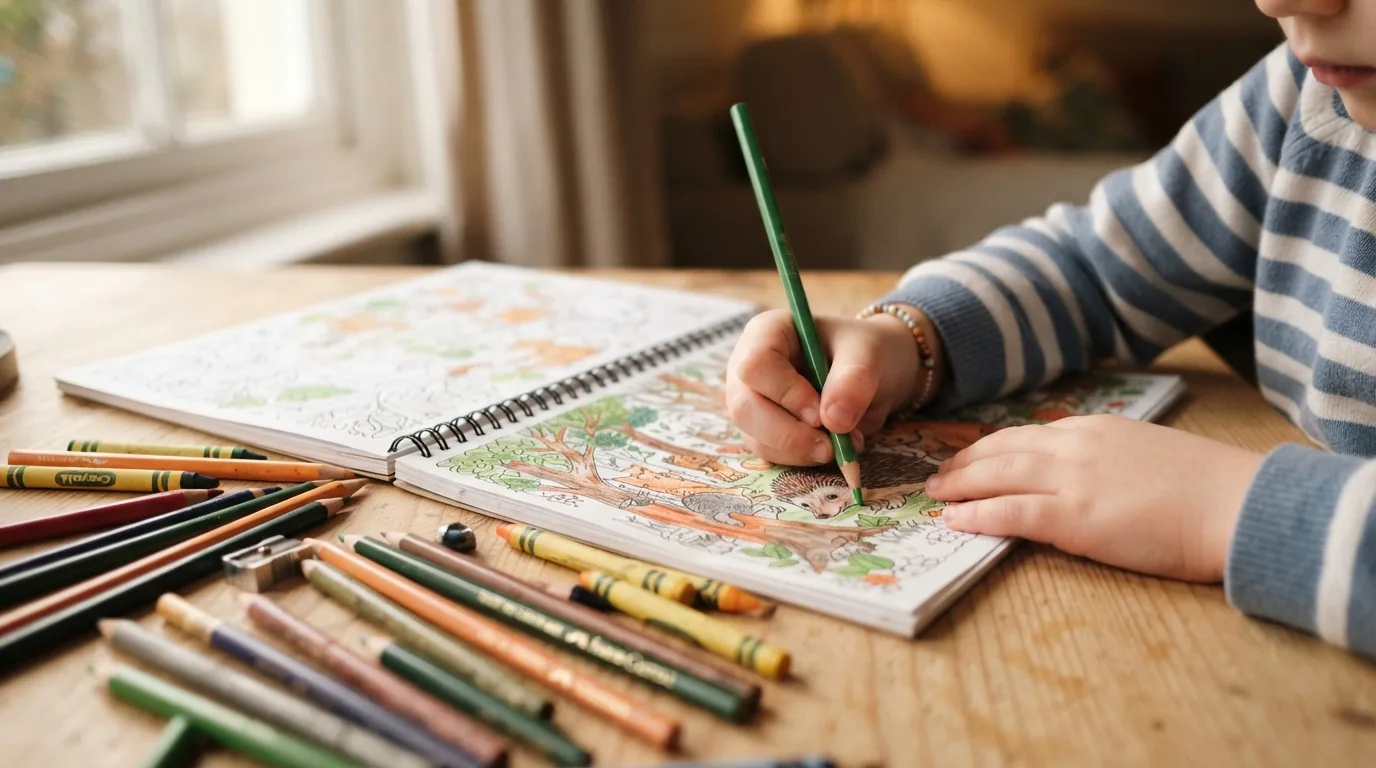
More Than Just Crayons and Paper When we think of a child coloring, we often imagine a quiet moment of play. But behind that quiet concentration, a "cognitive symphony" is playing. At MiniMinds, we design our coloring books not just for beauty, but as tools for intellectual growth. Scientific research shows that simple coloring activities are actually high-level workouts for a developing brain.
Here is how a simple coloring page transforms into a mental gym:
1. The Seeds of Critical Thinking Choosing the right shade for a dragon’s wing or deciding how to blend two colors involves critical thinking. Children analyze the task, evaluate their options, and make a decision. They aren't just filling in gaps; they are practicing the art of "choice and consequence" on a creative canvas.
2. Early Problem-Solving What happens when a child accidentally colors outside the line? Or when a crayon breaks? They learn to adapt. They might turn that "mistake" into a new pattern or learn to adjust their grip. These are the earliest forms of problem-solving—the ability to find solutions when things don't go exactly as planned.
3. Mastering Spatial Reasoning Coloring requires children to understand boundaries, shapes, and the relationship between objects. This is called spatial reasoning. By navigating the 2D space of a page, they are building the mental foundations for future skills in mathematics, geometry, and even engineering.
4. Memory and Language Development "What color is the sun in the sky? What was the name of the character in the story?" As children color, they recall information from the world around them, strengthening their memory. Discussing the picture with you—naming the animals or describing the scenery—also boosts their vocabulary and language skills.
The MiniMinds Mission Our mission is to make development fun. Every line we draw is meant to spark a question, and every page is an invitation to think deeper. Coloring is the first step toward a lifetime of curious and creative thinking.